

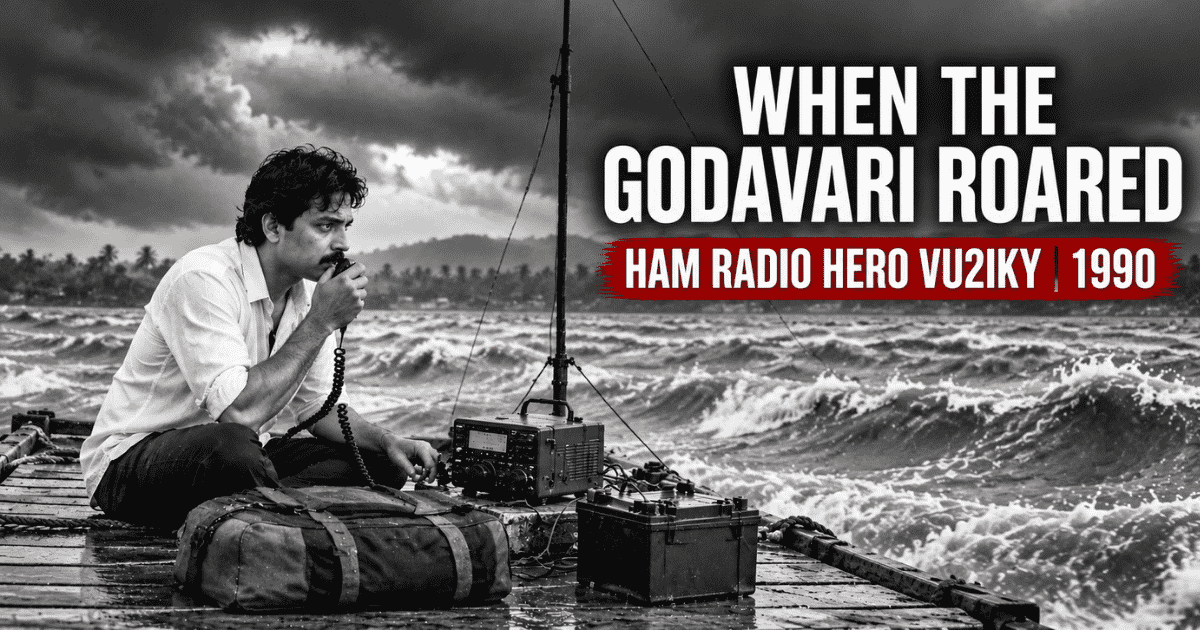
A remarkable story of courage, sacrifice, and amateur radio service by Dr. Prudhvi Raju Kakani, VU2IKY
When the Godavari Roared: Ham Radio Hero VU2IKY
In 1990, when the Godavari roared in fury and floodwaters threatened countless lives, a small village near Rudramakota stood isolated from the outside world. Electricity was unavailable, conventional communication systems had failed, and the frightened villagers had no reliable way to convey their desperate need for help.
At that time, Dr. Prudhvi Raju Kakani, VU2IKY, an amateur radio operator from Guntur and a member of the National Institute of Amateur Radio (NIAR), was living in Guntur with his wife and their three young children.
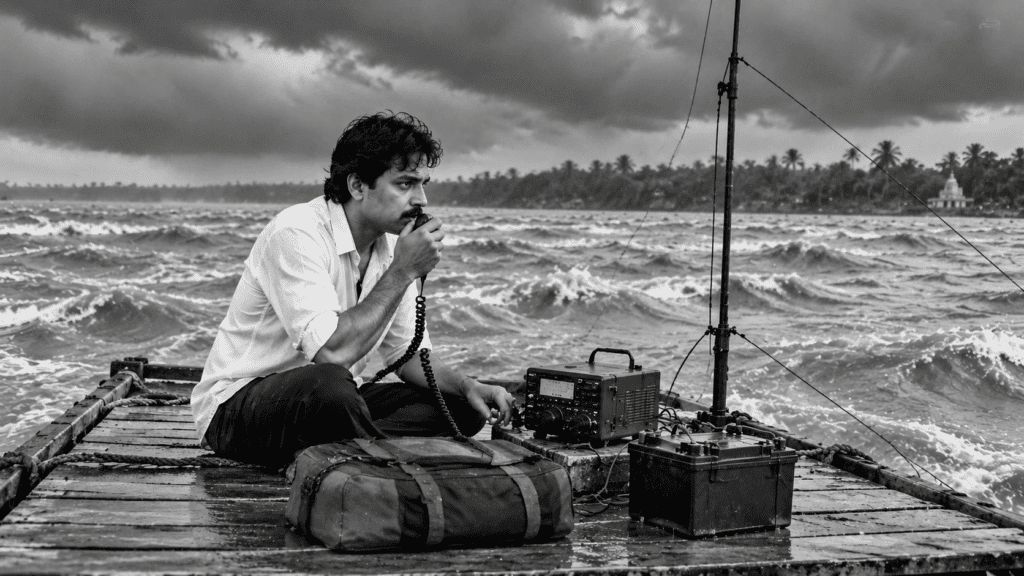
Like any devoted husband and father, he had responsibilities towards his family. Yet, when an urgent message arrived through the NIAR office and the Collectorate authorities, he did not hesitate. He understood that people trapped by the floods needed a lifeline, and he was determined to do whatever he could to provide it.
Leaving behind the comfort of his home and the warmth of his family, he set out alone on a mission into the unknown.
He collected an amateur radio set from NIAR and travelled from Guntur to Bhadrachalam. From there, he journeyed approximately 60 kilometres by bus to Rudramakota. His mission was far from complete. He still had to cross the mighty Godavari, swollen with floodwaters and swept by powerful winds, to reach kunavaram, a small village on the opposite bank.
He did not know whether he would reach the riverbank safely, whether a launch would be able to cross the turbulent waters, or whether he would find a suitable place to establish his radio station. Yet, he pressed forward, driven by a sense of duty towards people whose lives might depend on his communication link.
After crossing the river by launch, he reached kunavaram and took shelter in the residence of the local village assistant. The scene was frightening. The Godavari thundered nearby, the winds swept across the flooded landscape, and darkness surrounded the village. There was no electricity, and the villagers were gripped by uncertainty and fear.
But Prudhvi Raju did not surrender to the circumstances.
When there was no electricity, he searched for another source of power. When there was no communication, he searched for a way to reconnect the village with the world.
He spotted a nearby tractor and obtained its battery to power the radio equipment. Carrying his equipment to a slightly elevated location, he erected the antenna, connected the radio, and prepared to transmit.
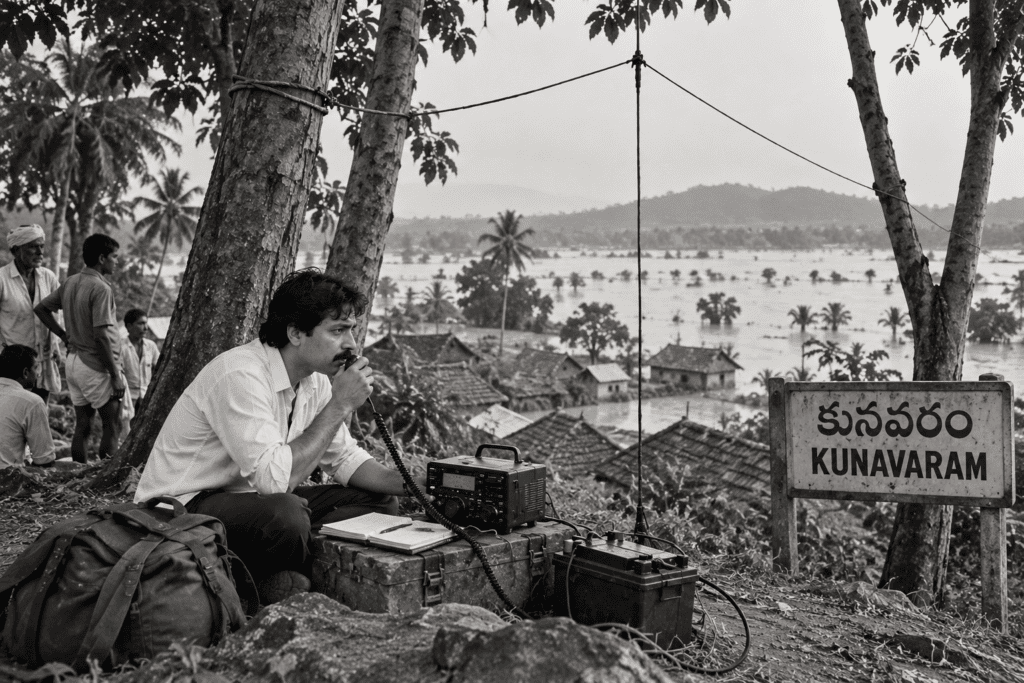
Then, amid the roar of the Godavari and the fury of the winds, a radio signal came alive.
A village that had been cut off from the outside world could once again communicate. Urgent information could be transmitted, the authorities could be alerted, and the needs of the flood-affected people could reach those capable of arranging assistance.
His successful effort helped relay critical information and requests for relief, including food supplies, to the authorities. In a disaster affecting thousands of people, that communication link became an invaluable contribution to the wider relief effort.
The significance of this act goes far beyond the equipment he carried or the distance he travelled. It lies in the courage of a man who undertook a dangerous journey alone, knowing that he might not succeed, yet refusing to allow uncertainty to prevent him from trying.
Back in Guntur, his wife and three young children awaited him. He had left them to undertake a mission whose outcome he could not predict. His actions reflected a profound belief that service to humanity sometimes demands personal sacrifice and extraordinary courage.
A Signal of Hope Amid the Fury of Nature
Dr. Prudhvi Raju Kakani’s story is a tribute to the true spirit of amateur radio. It reminds us that a radio operator’s greatest achievement is not simply making contact across great distances, but using that ability when communication matters most.
When the village lost its power, he found power in a tractor battery.
When the village lost its voice, he gave it a voice through amateur radio.
When the Godavari cut the village off from the world, he built a bridge across the silence.
And when fear threatened to overwhelm the people, he helped restore a vital connection to those who could provide assistance.
One man. One radio. One improvised power source. One determined mission.
That is the extraordinary human story behind the radio signal that reached beyond the flooded banks of the Godavari.
It is a reminder that courage is not the absence of fear, but the determination to act despite uncertainty. And it is a lasting tribute to amateur radio operators who place their technical knowledge at the service of humanity.
When disaster silences the world around us, a dedicated radio amateur can become the voice that brings hope.
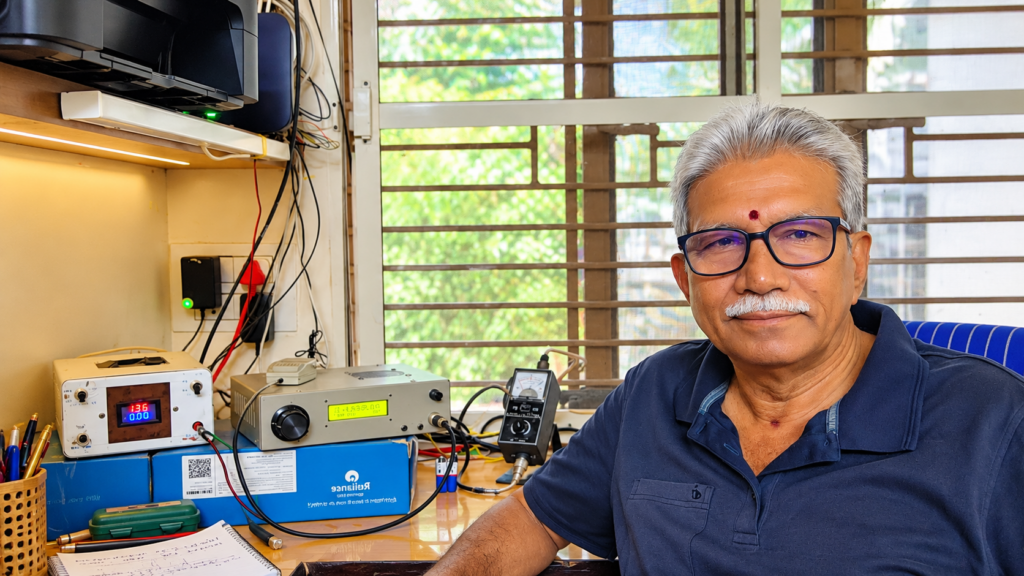
73 — Service before self, communication in times of crisis, and humanity above all.
Recommended articles
- The News Minute — “Godavari touches 70 ft at Telangana’s Bhadrachalam for first time since 1990”: .
2. Hindustan Times — “Bhadrachalam battles flooding after 32 years”: Gives the specific 1990 flood level as 70.8 ft,
3. “Cyclone: Timely warning and evacuation save many lives in Andhra Pradesh” (May 31, 1990):
4. The New York Times — “Furious Cyclone Has India Reeling” (May 13, 1990):