

An Amateur Radio Experience from VU2IKY
By Dr. Prithviraj Kakani – VU2IKY
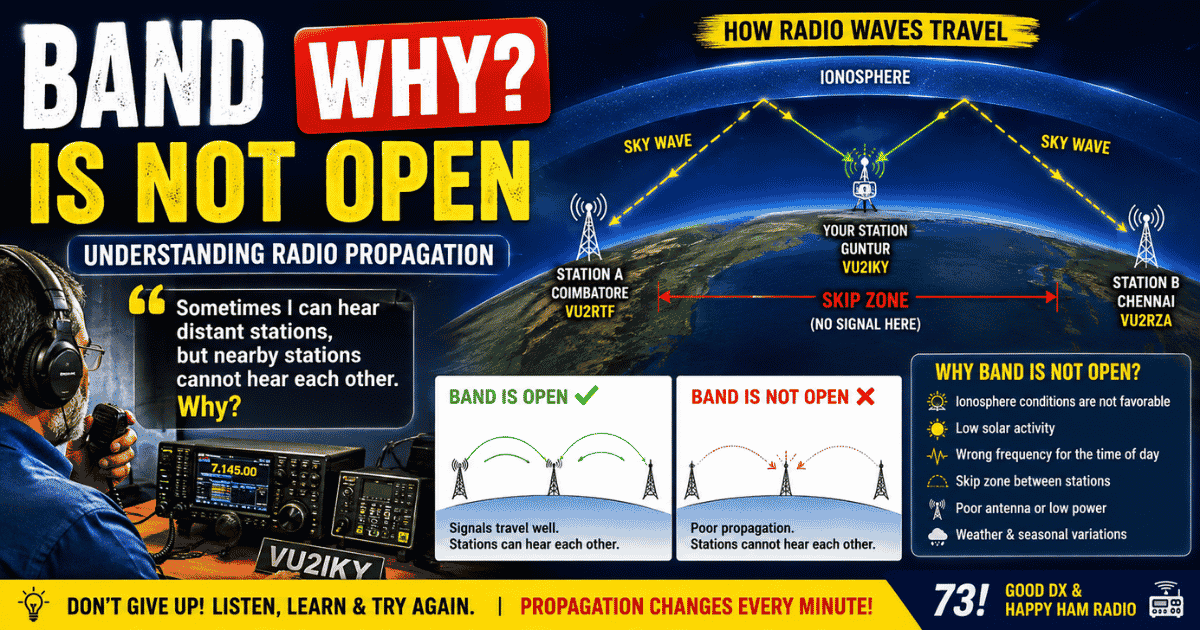
This morning, 11 August 2026, at about 6:45 a.m., I had an interesting experience on the amateur radio bands which reminded me once again how fascinating radio propagation can be.
From my station VU2IKY, I was able to receive two stations with good signals:
- VU2RTF – Balanna, Coimbatore
- VU2RZA – Dr. Subramanyam Chennai
Both stations were coming in with good and readable signals at my location.
But there was an interesting observation.
The signal from VU2RTF in Coimbatore was not being heard at Chennai by VU2RZA, even though the geographical distance between Coimbatore and Chennai is relatively small.
This raises an important question:
If I can hear both stations, why can’t they hear each other?
The answer lies in one of the most fascinating aspects of amateur radio — radio propagation.
What Does “The Band Is Not Open” Mean?
When amateur radio operators say:
“The band is not open.”
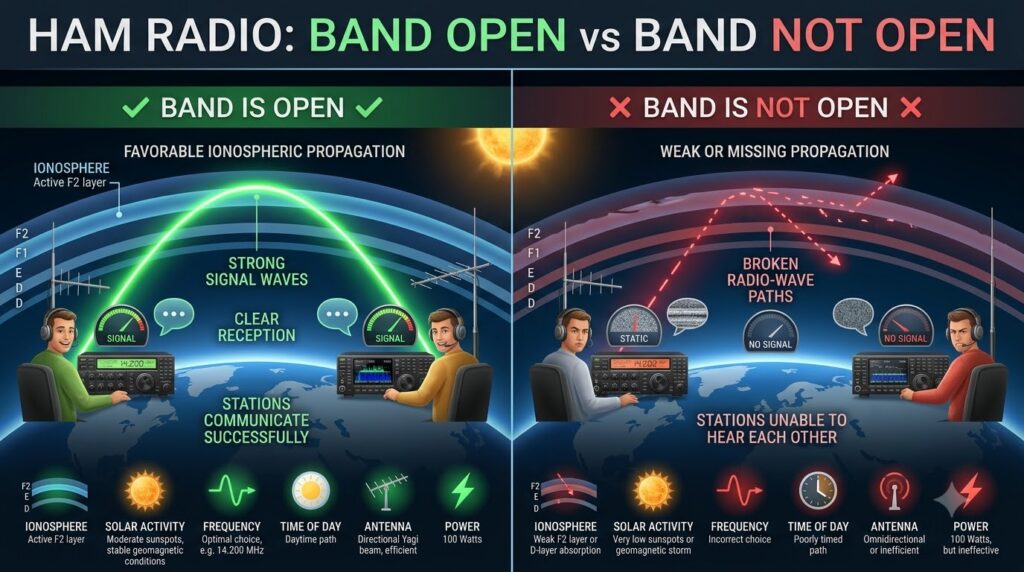
they generally mean that the particular propagation conditions required for a signal to travel over the desired distance are not currently favorable.
It does not mean that the transmitter is not working.
It does not necessarily mean that the antenna is bad.
It does not mean that nobody is transmitting.
Rather, it means that the radio waves are not propagating through the atmosphere in a way that allows stations at the desired distance to hear each other reliably.
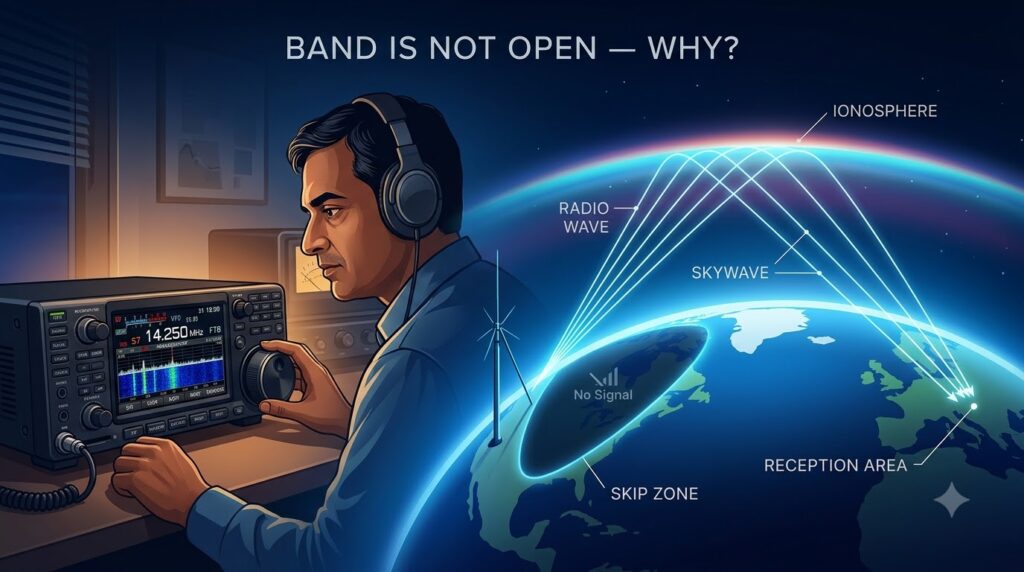
Propagation depends on several factors:
- Frequency
- Time of day
- Solar activity
- Ionospheric conditions
- Season
- Antenna height and direction
- Transmitter power
- Ground conditions
- Polarization
- Distance between stations
That is why an amateur band can suddenly become active and then become apparently “dead” a short time later.
But How Did VU2IKY Hear Both Stations?
This is the most interesting part of my experience today.
My station VU2IKY was geographically positioned so that I could receive signals from both Coimbatore and Chennai.
Conceptually, the situation looked something like this:
VU2RTF
Coimbatore
●
\
\
\ Good signal
\
●
VU2IKY
Guntur
/
/
/ Good signal
/
●
VU2RZA
Chennai
I was therefore in a position where signals from both directions were reaching my receiver.
But that does not automatically mean that the two other stations will hear each other.
Radio propagation is not always a simple “point-to-point” connection.
Understanding the Skip Zone
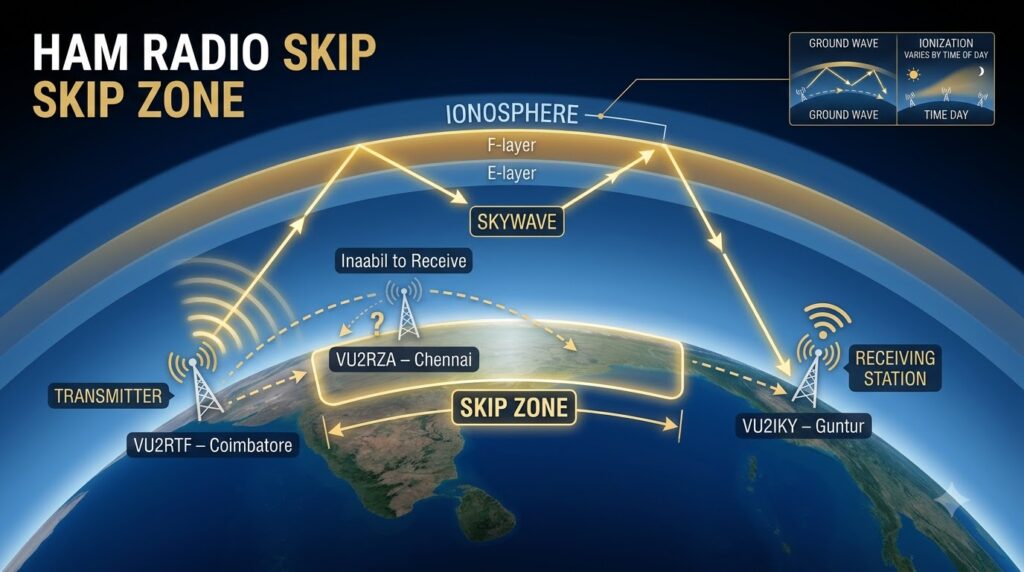
One of the most important concepts for newcomers is the skip zone.
Imagine that a transmitter sends radio waves toward the sky.
Depending on the frequency and propagation conditions, some of the energy may travel upward and return to Earth at a considerable distance from the transmitting station.
The area immediately around the transmitting station where that particular skywave cannot be heard is sometimes called the skip zone or skip distance.
A simplified picture is:
IONOSPHERE
─────────────────────────────
↑ ↓
│ │
Radio waves Radio waves
│ │
↗ ↘
/ \
/ \
/ \
TX ● ● RX
| |
| |
|<—- SKIP ZONE —–>|
The important point is that the signal may not be strongest immediately around the transmitting station.
It can disappear for a certain distance and then suddenly become strong again farther away.
This is one reason why a station hundreds or even thousands of kilometres away can sometimes be heard while a much closer station cannot.
The “Skip” Phenomenon
Think of throwing a stone into a pond.
The waves travel outward.
Radio propagation can behave somewhat like this, although the physics is much more complicated.
A skywave can travel upward, interact with the ionosphere, and return to Earth some distance away.
Conceptually:
IONOSPHERE
───────────────────────────
/\
/ \
/ \
/ \
/ \
/ \
/ \
/ \
/ \
TX ● ● RX
<— SKIP —>
The first point where the skywave returns to Earth can be called the skip distance.
The area between the transmitter and that first return point can experience weak or no skywave reception.
Why Can a Distant Station Be Heard While a Nearby Station Cannot?
This is where propagation becomes really interesting.
Suppose a station is transmitting on a frequency where the signal is propagating mainly through the ionosphere.
The signal may “jump” over a nearby area and return farther away.
For example:
TX VU2IKY
● ●
| |
| SKIP ZONE |
|<————————->|
| |
| |
└──────── SKY WAVE ─────────┘
Therefore:
Distance alone does not determine whether a station can be heard.
Propagation determines whether the signal can reach the receiving station.
My Experience This Morning
Coming back to today’s observation:
At approximately 6:45 a.m., I was operating VU2IKY.
I could hear:
VU2RTF – Balanna, Coimbatore
and
VU2RZA – Chennai
with good signals.
Yet the Coimbatore station was apparently not reaching Chennai.
This illustrates an important point:
Radio propagation is not necessarily symmetrical from the perspective of different stations.
The path from:
Coimbatore → VU2IKY
may have been favorable.
The path from:
Chennai → VU2IKY
may also have been favorable.
But that does not guarantee that:
Coimbatore → Chennai
will be equally favorable.
A Simple Illustration
Consider three stations:
COIMBATORE GUNTUR CHENNAI
VU2RTF VU2IKY VU2RZA
● ● ●
\ / \ /
\ / \ /
\ / \ /
\_______________/ \_______________/
GOOD PATH GOOD PATH
Coimbatore → Guntur Guntur ← Chennai
BUT
Coimbatore ───────────X────────── Chennai
WEAK / NO PATH
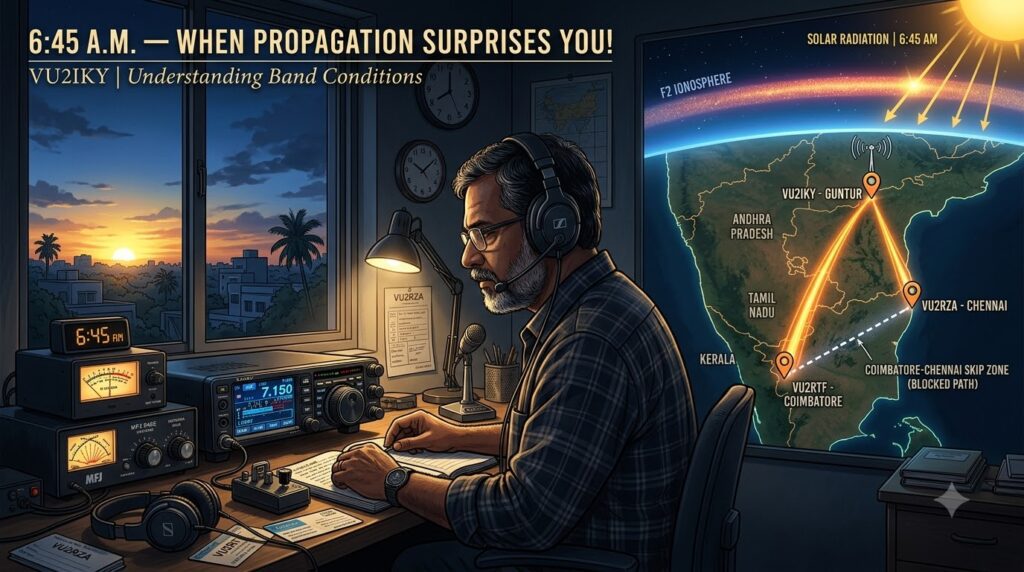
This is a simplified illustration, because real propagation is three-dimensional and depends on the actual frequency and propagation mechanism.
But it helps newcomers understand the basic idea:
A station may be audible at one location but inaudible at another location, even when those two stations are relatively close to each other.
What Is a “Dead Band”?
Amateurs often say:
“The band is dead.”
This is usually an informal way of saying that current propagation conditions are not supporting useful contacts on that frequency or band.
For example:
06:00 Weak signals
06:30 Signals appearing
06:45 Good propagation
07:15 Signals weakening
08:00 Band apparently dead
The same band may behave completely differently later in the day.
This is why experienced amateur radio operators constantly listen to the band.
Sometimes the best information is obtained not by transmitting, but by listening.
Why Time of Day Matters
Today’s observation at 6:45 a.m. is also interesting because propagation conditions change dramatically around sunrise and sunset.
The ionosphere is constantly changing.
Solar radiation produces and modifies ionized layers of the upper atmosphere. These layers can influence how radio waves travel.
Therefore:
Night ≠ Morning ≠ Afternoon ≠ Evening
A frequency that is excellent at 6:45 a.m. may not behave in the same way at noon.
Likewise, a band that appears dead at one time may suddenly come alive later.
The Ionosphere — Nature’s Radio Mirror
For many HF communications, the ionosphere plays an important role.
A very simplified representation is:
SUN
☀
↓
Solar radiation
↓
┌─────────────────────┐
│ IONOSPHERE │
│ D / E / F regions │
└─────────────────────┘
↗ ↘
/ \
/ \
/ \
TX ● ● RX
Radio waves can interact with different ionospheric regions depending on frequency and conditions.
This is why amateur radio operators become fascinated with propagation.
We are effectively using the Earth’s atmosphere as part of our communication system.
Skip Is Not Always a Problem
For newcomers, the word “skip” can sound like something undesirable.
But in amateur radio, skip can be extremely useful.
Without suitable skywave propagation, many long-distance HF contacts would not be possible.
A station thousands of kilometres away can sometimes produce a very strong signal because the propagation path happens to be excellent.
At the same time, a station much closer may be difficult or impossible to hear.
This is one of the great surprises for a newcomer:
Far away does not always mean weak, and nearby does not always mean strong.
What Young Radio Operators Should Learn From This
My experience today is a good lesson for young amateur radio operators and newcomers.
When you don’t hear a station, don’t immediately conclude:
“The transmitter is not working.”
Instead, ask:
- What frequency am I using?
- What time is it?
- What is the propagation condition?
- Is there a skip zone?
- Is the antenna suitable?
- Is the signal arriving through ground wave or skywave?
- Is the other station inside a propagation blind area?
- Are there other stations reporting the same phenomenon?
Most importantly:
Listen!
Spend some time monitoring the frequency before transmitting.
You may suddenly hear a station that was completely absent just a few minutes earlier.
An Important Lesson From VU2IKY
Today’s experience with VU2RTF in Coimbatore and VU2RZA in Chennai reminded me once again why I became fascinated with amateur radio.
We often think:
Station A transmits → Station B receives.
But the real picture is much more interesting:
Station A → Antenna → Atmosphere/Ionosphere → Propagation Path → Antenna → Station B
The atmosphere itself becomes part of our communication system.
And that atmosphere is constantly changing.
That is why every day on amateur radio can bring a new surprise.
Final Message to Newcomers
If you are new to amateur radio, don’t be discouraged when someone tells you:
“The band is not open.”
It simply means:
“At this moment, the propagation conditions are not favorable for the communication path we want.”
Wait.
Listen.
Observe.
Try another frequency.
Try another time.
Check propagation reports.
And most importantly, keep experimenting.
Because sometimes, when you think the band is completely dead, a signal from hundreds or thousands of kilometres away can suddenly appear from the noise — 59, loud and clear!
That is the magic of Amateur Radio.
73!
Dr. Prithviraj Kakani
VU2IKY
Amateur Radio Operator